Lifesaving Naloxone available to students at San Diego State University
By: Ruben Alarcon
April 24,2026
Story highlights
- Student opioid overdoses are a reality and there is a life saving measure that is available to them at San Diego State University.
- Naloxone can make a difference in saving student lives by preventing accidental overdose deaths.
- California’s Campus Opioid Safety Act requires colleges and universities to make Naloxone available, but there are barriers to students accessing it in the form of stigma and lack of awareness.
- Naloxone use training in the event of an overdose is available to SDSU students by the Department of Well-being and Health Promotion and the medication is also provided for free.
SAN DIEGO – “It saved my life.” Those are the words of Benjamin Massinga, a former San Diego State University student.
After experiencing an overdose from opioids, Massinga was treated with Naloxone to help reverse the deadly effects before it was too late. Massinga has also been on the other side of the situation, having administered Naloxone to a person that was overdosing.
Naloxone has become one of the biggest tools used in the fight to prevent death from opioid overdose and is available to students on campus at SDSU. The medication reverses the effects of opioids by blocking opioid receptors in the brain.
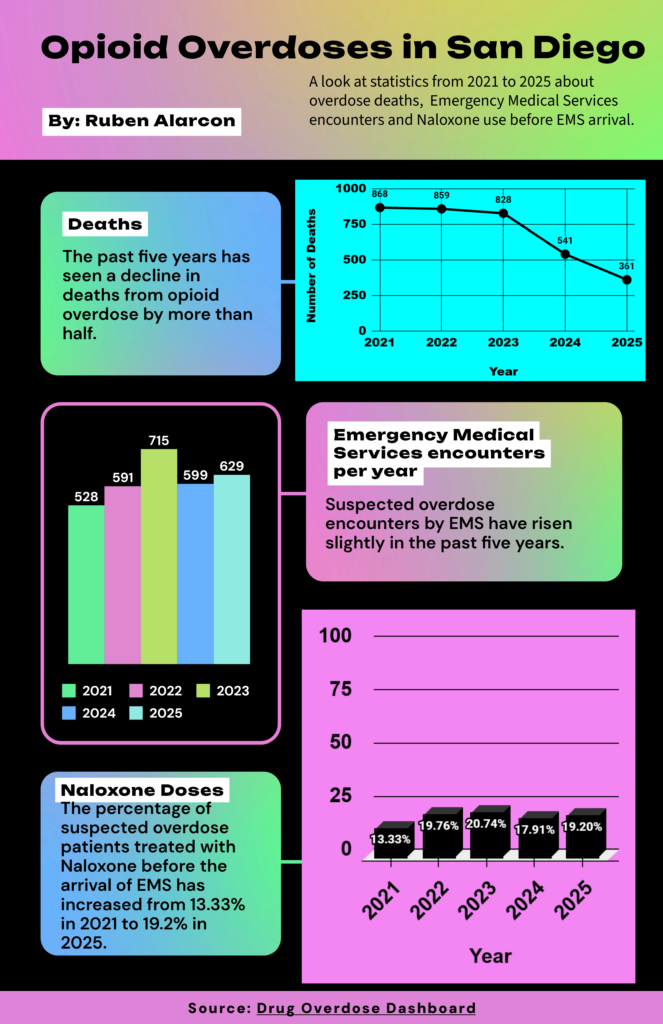
Data shows the effects of Naloxone access
The data collected by San Diego County shows that deaths due to opioid overdose have decreased in the past five years despite a slight increase in encounters with Emergency Medical Services. Another factor that has seen an increase is the percentage of people suspected of overdosing being treated with Naloxone prior to the arrival of EMS. This increase may connect with the implementation of the county’s EMS Leave Behind Naloxone Program in 2022, a program that was announced in 2020. The data suggests that access to the overdose reversing medication makes an impact in reducing deaths.
“I feel like you can find it at SDSU, but you have to go looking for it,” Massinga said. “I don’t see it on my normal day-to-day on SDSU campus.”
Students can go through online training through the university’s website and request medication from the Department of Well-being and Health Promotion or at the campus pharmacy.
Yet, even students that have gone through the training don’t know where to get it on campus.
“Not currently, not on campus,” SDSU Student Aidan Gibbs said.
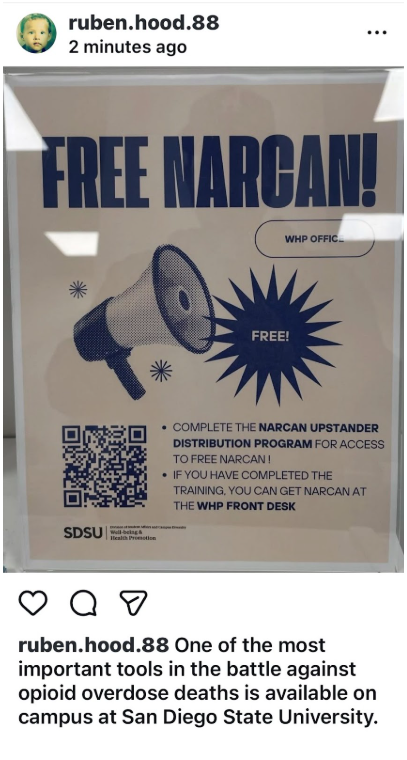
SDSU Well-being and Health Promotion provides information, training and Naloxone to students at SDSU
Overdose due to opioids has become a grave problem as one of the top causes of death in the U.S. and university campuses have not been immune to this epidemic. Between 2020 and 2024, 16,191 people aged 15 to 24 died due to overdose, according to the CDC .
In 2023, California instituted the Campus Opioid Safety Act requiring most public colleges to provide education, information, and Naloxone on campus. SDSU is one of those colleges, but has been providing Naloxone since 2019, according to Recovery Specialist at Department of Well-being and Health Promotion, Miriam Rodriguez.
“We want everyone to know that it’s there and it’s available.” Rodriguez said. Her emphasis reflects what the law is hoping to achieve.
The law only applies to community college districts and California State University campuses. The University of California system is only encouraged to do the same.
The University of San Diego and University of California San Diego have followed the suggestion and have Naloxone distribution programs similar to SDSU, according to their websites.
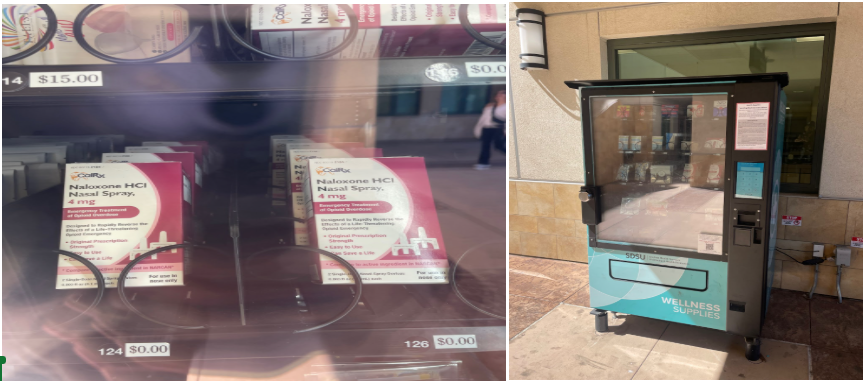
The Wellness Supplies vending machine in Calpulli Center. Photo by: Rubén Alarcón
The Naloxone Upstander Distribution Program has been available through the SDSU Department of Well-being and Health Promotion since 2023 and is a training that is provided to students teaching them how to administer the medication.
All students are supposed to be given information about opioid overdose and the Naloxone training during new student orientation, according to Rodriguez. Although not all students go through the training.
“I’ve never done the training,” SDSU student Monica Watson said.
The training includes a 23-minute video presentation and a questionnaire about the information provided in the video. Once the training is completed, students are given Naloxone at no charge.
“Everyone does have access to it on campus and then we also do a lot of tabling and outreach where we’re doing a lot of events on campus,” Rodriguez said.
There are also overdose emergency kits located at various locations around campus.
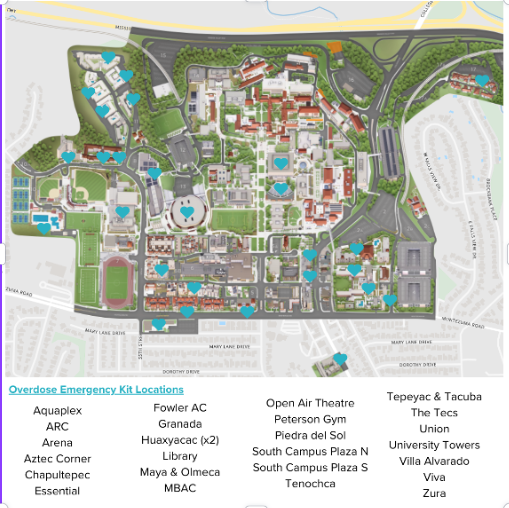
The Overdose Emergency Kit locations on SDSU campus.
Barriers prevent students from accessing Naloxone
One of the barriers that still affects students accessing Naloxone is the perception others will have of them if they have it in their possession.
“There’s still a lot of stigma tied to it,” Linsey Belisle said, an assistant professor of criminal justice at Boise State University. “Like if someone is carrying, there is a jump to conclusions that ‘Oh, well you’re only carrying that because you’re using substances’.”
An observation that is echoed by people that have experienced an overdose is that carrying Naloxone can carry negative connotations. Students might be concerned with how others will view them.
“A lot of people are like ‘why would I have it if I don’t use drugs,’” Massinga said. “It should be everyone that has one.”